By Dr. Lisa Valente · Published April 6, 2025 · 9 min read
An IIFYM calculator takes the guesswork out of flexible dieting by converting your body stats and goals into precise daily targets for protein, carbohydrates, and fat. Instead of following a rigid meal plan that tells you exactly what to eat, IIFYM — short for If It Fits Your Macros — gives you a numerical framework and lets you fill it with the foods you actually enjoy.
The approach has gained traction for good reason. A 2021 randomized controlled trial published in the Journal of the International Society of Sports Nutrition found that flexible dieters achieved the same fat loss as rigid dieters while gaining significantly more lean mass during the recovery phase. The takeaway: what you eat matters less than whether your macro totals add up at the end of the day.
Below, you will learn exactly how an IIFYM calculator works, how to set your own macros step by step, and how to avoid the most common mistakes that derail beginners.
What Is IIFYM (If It Fits Your Macros)?
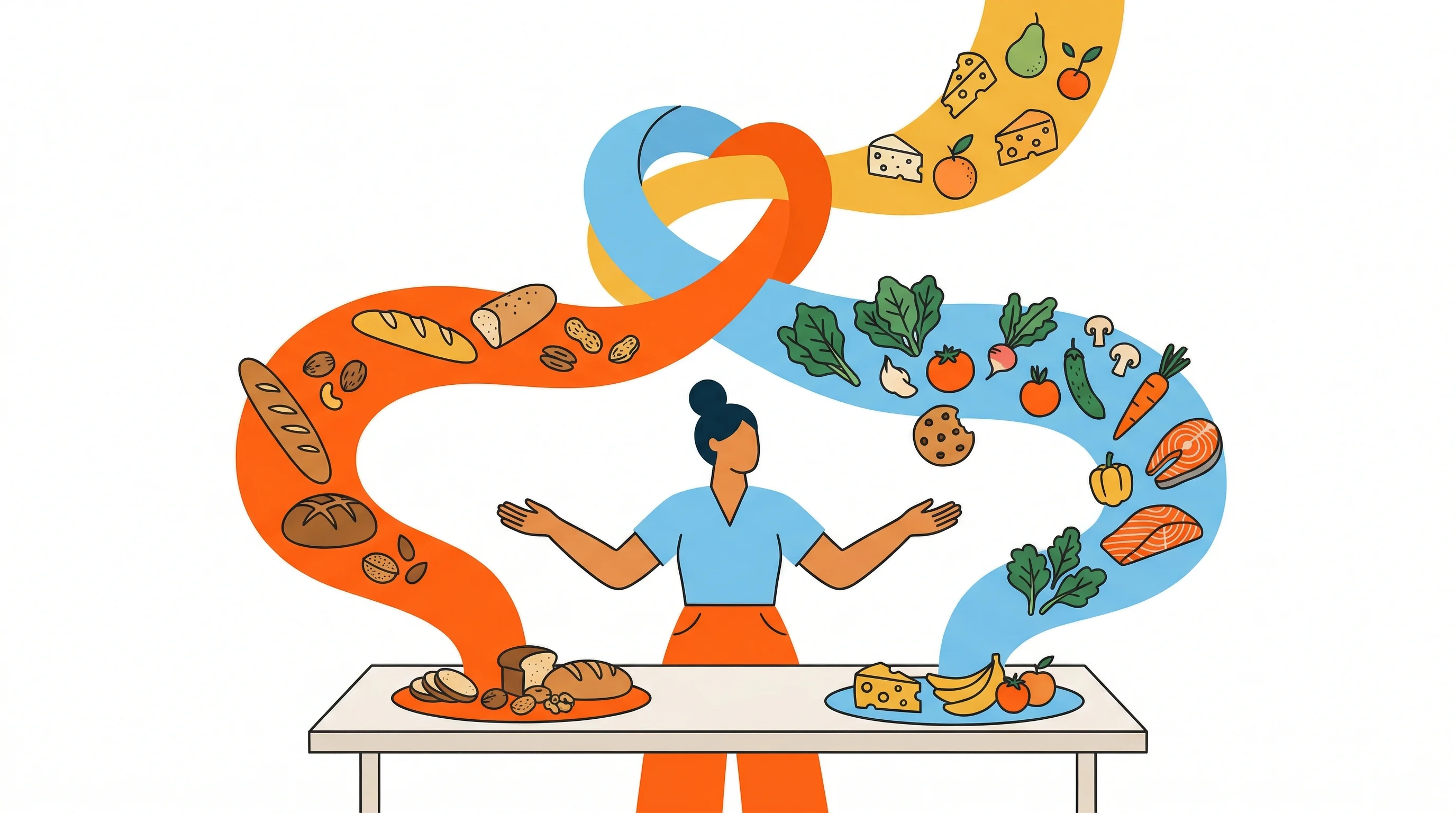
IIFYM is a dietary approach that focuses on hitting daily macronutrient targets — protein, carbohydrates, and fat — rather than labeling foods as "clean" or "dirty." As long as your daily totals land within your prescribed ranges, you have the freedom to choose which foods get you there.
The concept emerged in bodybuilding forums in the early 2010s as a reaction to the rigid "bro diet" culture of chicken, rice, and broccoli at every meal. Competitors discovered that body composition outcomes depended more on consistent macro and calorie totals than on food selection alone.
Three principles define IIFYM:
- Calorie targets come first. Every IIFYM plan starts with a calorie goal derived from your Total Daily Energy Expenditure (TDEE).
- Macros subdivide those calories. Protein, carbs, and fat each play distinct metabolic roles, so the split matters — not just the total. Each gram of protein provides 4 calories, each gram of carbs provides 4 calories, and each gram of fat provides 9 calories.
- Food choice is flexible. No food is banned. You build meals from whatever sources fit your remaining macro budget for the day.
IIFYM Is Not a Free-for-All
Flexible does not mean unstructured. Successful IIFYM practitioners still prioritize whole foods for the bulk of their intake — they simply leave room for foods that traditional diets would forbid. Research calls this a "flexible restraint" approach, and it is associated with lower rates of overeating, lower BMI, and reduced anxiety around food.
How an IIFYM Calculator Works
An IIFYM calculator automates the math behind flexible dieting in four steps. Understanding each step helps you interpret the results — and adjust them when your body responds differently than expected.
Step 1 — Estimate Your Basal Metabolic Rate
Your Basal Metabolic Rate (BMR) is the number of calories your body burns at complete rest — breathing, circulating blood, maintaining body temperature. Most IIFYM calculators use the Mifflin-St Jeor equation, which research has shown to be the most accurate predictive formula for the general population:
- Men: BMR = (10 × weight in kg) + (6.25 × height in cm) − (5 × age) + 5
- Women: BMR = (10 × weight in kg) + (6.25 × height in cm) − (5 × age) − 161
Step 2 — Multiply by an Activity Factor
Your BMR only accounts for resting energy. To estimate total daily calorie burn, the calculator multiplies your BMR by an activity multiplier:
| Activity Level | Multiplier | Example |
|---|---|---|
| Sedentary | 1.2 | Desk job, no exercise |
| Lightly active | 1.375 | 1-3 light workouts per week |
| Moderately active | 1.55 | 3-5 moderate workouts per week |
| Very active | 1.725 | 6-7 intense workouts per week |
| Extremely active | 1.9 | Athlete or physical labor job |
The result is your TDEE — the estimated number of calories you burn in a full day. For a deeper breakdown, see our guide on how many calories you should eat.
Step 3 — Apply a Calorie Adjustment
Your goal determines whether you eat above, below, or at your TDEE:
- Fat loss: Subtract 15–25% from TDEE (a moderate calorie deficit)
- Maintenance: Eat at TDEE
- Muscle gain: Add 10–20% to TDEE
Step 4 — Distribute Calories Across Macros
This is the step that separates IIFYM from simple calorie counting. The calculator converts your adjusted calorie target into grams of protein, carbs, and fat.
Protein is set first because it has the strongest evidence base for a specific minimum threshold. Most research supports 0.7–1.0 g of protein per pound of body weight for active individuals — well above the RDA minimum. To learn more about setting your protein floor, read our guide on daily protein requirements.
Fat is set next, typically at 0.3–0.5 g per pound of body weight, to support hormone production and nutrient absorption. The remaining calories are assigned to carbohydrates.
Calculate Your IIFYM Macros: Step by Step
Here is the full process you can follow right now with nothing more than a calculator and a bathroom scale.
Worked Example: 170 lb (77 kg) Moderately Active Male, Age 30, 5'10" (178 cm)
- BMR = (10 × 77) + (6.25 × 178) − (5 × 30) + 5 = 770 + 1112.5 − 150 + 5 = 1,738 kcal
- TDEE = 1,738 × 1.55 = 2,694 kcal
- Fat loss target = 2,694 × 0.80 = 2,155 kcal
- Protein = 170 g × 4 cal = 680 cal
- Fat = 68 g × 9 cal = 612 cal
- Carbs = (2,155 − 680 − 612) ÷ 4 = 216 g
Daily targets: 2,155 kcal · 170 g protein · 68 g fat · 216 g carbs
IIFYM Macro Splits by Goal
The table below shows common macro distributions. These are starting points — individual responses vary, so adjust after two to four weeks of consistent tracking.
| Goal | Protein | Carbs | Fat | Calorie Adjustment |
|---|---|---|---|---|
| Fat loss | 30-35% | 30-40% | 25-35% | −15 to −25% from TDEE |
| Maintenance | 25-30% | 40-50% | 25-30% | At TDEE |
| Muscle gain | 25-30% | 40-50% | 20-30% | +10 to +20% above TDEE |
| Endurance sport | 20-25% | 50-60% | 20-25% | +5 to +15% above TDEE |
| Keto / low carb | 25-30% | 5-10% | 60-70% | Varies by goal |
Activity Level Is the #1 Source of Error
Most people overestimate how active they are. If you work a desk job and exercise three times per week, "lightly active" is usually more accurate than "moderately active." Starting conservatively prevents inflated calorie targets that stall progress.
IIFYM vs Traditional Dieting
How does flexible dieting compare to more rigid approaches? The research is clear: adherence beats perfection.
| Factor | IIFYM (Flexible Dieting) | Traditional / Rigid Dieting |
|---|---|---|
| Food choice | Any food that fits your macros | Restricted to "approved" foods |
| Sustainability | Higher — less restriction fatigue | Lower — rigid rules lead to burnout |
| Fat loss results | Equal when calories and protein match | Equal when calories and protein match |
| Lean mass retention | Slightly better in post-diet phase | More lean mass loss after dieting |
| Eating disorder risk | Lower rates of binge eating | Higher rates of disordered eating |
| Micronutrient intake | Depends on food choices (80/20 rule) | Often higher if focused on whole foods |
| Learning curve | Requires macro tracking skills | Simpler rules but less personalized |
A key 1999 study by Smith et al. found that flexible dietary restraint was associated with the absence of overeating, lower body mass, and lower levels of depression and anxiety — while rigid restraint predicted the opposite pattern.
Common IIFYM Mistakes to Avoid
Even experienced trackers fall into these traps. Avoiding them will save you weeks of stalled progress.
-
Ignoring micronutrients and fiber. Hitting your macros with mostly processed food is technically possible but nutritionally poor. Aim for 25–35 g of fiber daily and eat a variety of fruits, vegetables, and whole grains to cover vitamin and mineral needs.
-
Setting protein too low. The RDA of 0.36 g per pound is a minimum to prevent deficiency, not an optimum. Active individuals benefit from 2–3 times that amount to support muscle protein synthesis and satiety.
-
Not weighing food. Eyeballing portions leads to 30–50% underreporting, according to NIH research. A kitchen scale and a tracking app eliminate this error. Learn the full process in our guide on how to calculate food calories.
-
Changing macros too often. Give any new macro split at least two weeks before adjusting. Body weight fluctuates daily due to water, sodium, and digestion — short-term changes are noise, not signal.
-
Treating IIFYM as a junk-food pass. The "if it fits" philosophy works best with an 80/20 rule: 80% nutrient-dense whole foods, 20% discretionary choices. This ensures adequate micronutrition while preserving the flexibility that makes the approach sustainable.
Frequently Asked Questions
Is IIFYM good for weight loss?
Yes. IIFYM works for weight loss because it still requires a calorie deficit — you reach that deficit by hitting macro targets rather than following a strict meal list. A 2021 randomized controlled trial found flexible dieters lost equal fat mass as rigid dieters while retaining more lean tissue during the post-diet phase.
What is the best macro ratio for IIFYM?
There is no universal best ratio. A solid starting point for fat loss is 30% protein, 35% carbs, and 35% fat. For muscle gain, try 30% protein, 45% carbs, and 25% fat. Adjust every two to four weeks based on how your body weight, energy, and performance respond.
Can you eat junk food on IIFYM?
Technically, yes — as long as it fits your macro targets. In practice, most experienced IIFYM practitioners follow the 80/20 rule: 80% of calories from whole, nutrient-dense foods and 20% from treats or convenience foods. This keeps micronutrient and fiber intake adequate while allowing flexibility.
How is IIFYM different from calorie counting?
Calorie counting tracks total energy intake only. IIFYM adds a layer by specifying how those calories divide among protein, carbs, and fat. This matters because the same 2,000 calories can produce different outcomes for muscle retention, hunger, and hormonal balance depending on macro composition.
Start Tracking Your Macros
Knowing your macro targets is the first step — tracking them consistently is what drives results. The biggest barrier to IIFYM success is the friction of logging every meal manually.
If you want to see exactly how your meals stack up, try Caloria — just snap a photo and get your calorie and macro breakdown instantly. No barcode scanning, no manual searching through databases.
Download Caloria and see what you are really eating: