By Dr. Jane Smith · Published July 8, 2025 · 9 min read
Your body fat percentage calculator tells you something your bathroom scale never can: how much of your weight is fat versus lean tissue. That distinction matters far more than total weight when it comes to health risk, athletic performance, and tracking real progress. This guide walks you through the most practical calculation method, the formulas behind it, healthy ranges by age and sex, and — critically — what to actually do with the number once you have it.
Medical Disclaimer
The formulas and ranges in this article are evidence-based population averages and general guidelines. They do not constitute medical advice. Consult a registered dietitian or physician before making significant changes to your diet or exercise programme, especially if you have an underlying health condition.
What Is Body Fat Percentage?
Body fat percentage is the proportion of your total body weight that is made up of fat tissue. If you weigh 70 kg and carry 14 kg of fat, your body fat percentage is 20%.
Your body contains two categories of fat. Essential fat is the minimum fat required for normal physiological function — it protects organs, supports hormone production, and is critical for the nervous system. Storage fat is the reserve energy deposited in adipose tissue. Health problems arise when storage fat accumulates beyond a healthy threshold.
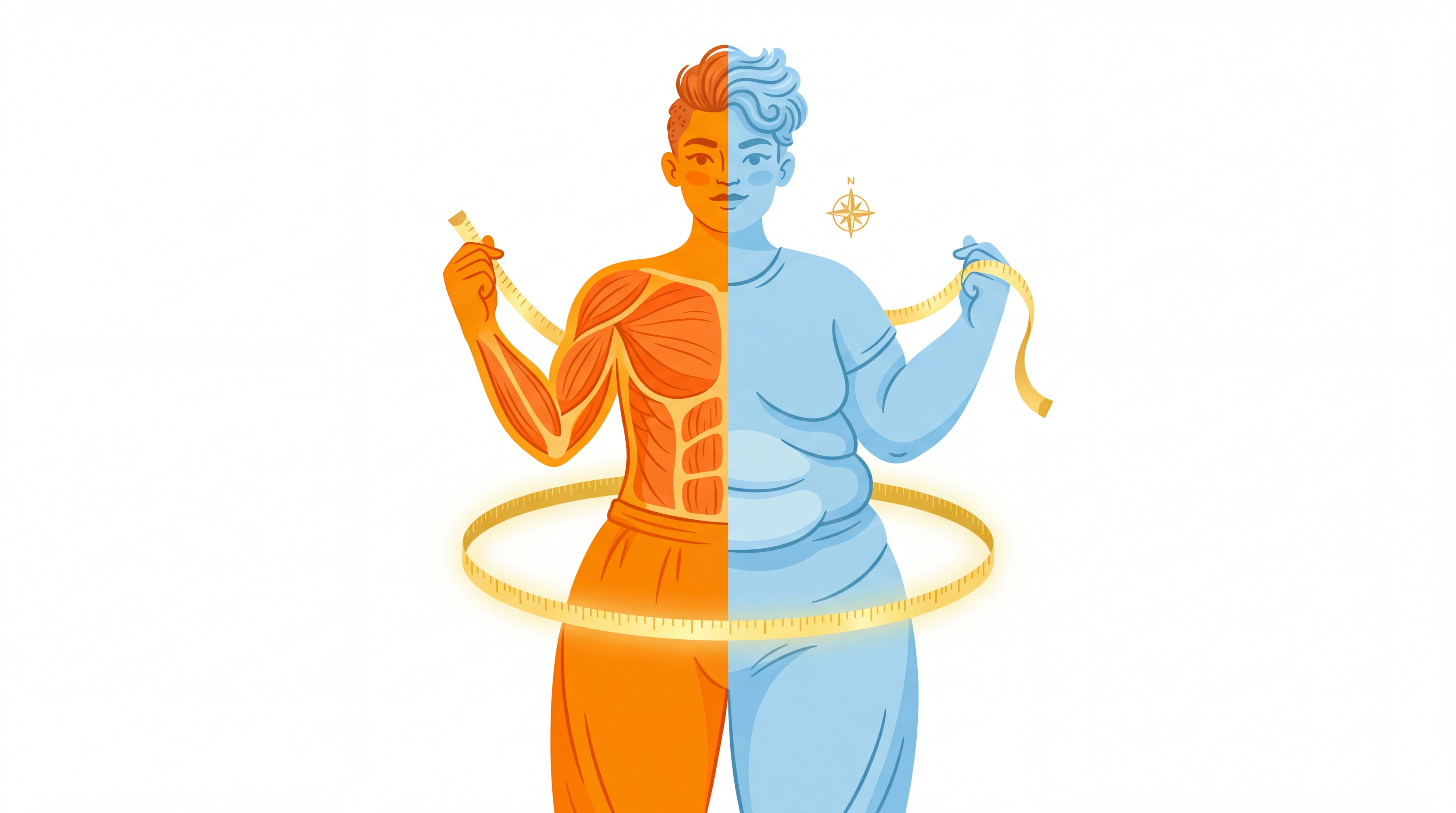
Unlike body weight alone, body fat percentage gives you a picture of your body composition — the ratio of fat mass to lean mass (muscle, bone, water, and organs). Two people at the same weight can have radically different health profiles depending on how their weight is distributed.
How to Calculate Your Body Fat Percentage
Several methods exist, ranging from clinical scans to simple tape measures. The U.S. Navy circumference method is the most practical for home use: it requires only a flexible tape measure and is accurate to within ±3–4 percentage points for most people.
The Navy Method Formulas
For men, measure neck circumference and abdomen circumference (at the navel), both in centimetres. Measure height in centimetres.
% Body Fat = 86.010 × log₁₀(abdomen − neck) − 70.041 × log₁₀(height) + 36.76
For women, add a hip measurement at the widest point.
% Body Fat = 163.205 × log₁₀(waist + hip − neck) − 97.684 × log₁₀(height) − 78.387
These formulas were developed by the U.S. Department of Defense and are validated against hydrostatic weighing data. A 2017 review of body composition techniques published in PMC confirms circumference-based methods are among the most accessible field assessments available.
Step-by-Step: Measure Yourself
Quick Example (Men)
A man who is 178 cm tall, with a 90 cm abdomen and a 38 cm neck:
- Abdomen − neck = 90 − 38 = 52 cm → log₁₀(52) ≈ 1.716
- Height = 178 cm → log₁₀(178) ≈ 2.250
- % Body Fat = (86.010 × 1.716) − (70.041 × 2.250) + 36.76 ≈ 19.9%
That result sits comfortably in the "acceptable" range for a man in his 30s (see the table below).
Healthy Body Fat Percentage Ranges
Healthy body fat varies by sex and increases naturally with age as muscle mass tends to decline. The ranges below draw on the landmark Gallagher et al. reference study (Am J Clin Nutr, 2000) and the American Council on Exercise (ACE) classification.
By Category (ACE Classification)
| Category | Men | Women |
|---|---|---|
| Essential fat | 2–5% | 10–13% |
| Athletes | 6–13% | 14–20% |
| Fitness | 14–17% | 21–24% |
| Acceptable | 18–24% | 25–31% |
| Obese | 25%+ | 32%+ |
By Age Group
Body fat naturally rises as lean mass decreases after the mid-30s, so healthy thresholds shift upward with age.
| Age | Men (healthy range) | Women (healthy range) |
|---|---|---|
| 20–39 | 8–20% | 21–33% |
| 40–59 | 11–22% | 23–35% |
| 60–79 | 13–25% | 24–36% |
If your reading falls outside these ranges, that is useful data — not a verdict. Body fat percentage is one indicator among many, and context (training history, medical conditions, ethnicity) affects what "healthy" means for you individually.
Body Fat Measurement Methods Compared
Not all measurement tools are created equal. Here is how the main methods compare on accuracy, cost, and convenience:
| Method | Accuracy (±) | Cost | Requires |
|---|---|---|---|
| DXA/DEXA scan | 1–2% | High ($50–200/session) | Clinical facility |
| Hydrostatic weighing | 1–3% | Moderate ($25–75) | Specialist lab |
| Air displacement (Bod Pod) | 2–3% | Moderate | Specialist lab |
| Navy tape measure method | 3–4% | Free | Tape measure only |
| Bioelectrical impedance (BIA) | 3–5% | Low ($30–150 scale) | BIA scale or device |
| Skinfold calipers | 3–5% | Low ($10–30) | Trained technician or practice |
For most people tracking progress at home, the Navy method or a consistent BIA scale offers the best balance of accuracy and practicality. The key is consistency: use the same method and conditions each time (same time of day, same hydration state) so your trend line is meaningful.
Body Fat Percentage vs. BMI
BMI (Body Mass Index) is calculated from weight and height alone. It is fast and requires no equipment, but it cannot distinguish fat mass from lean mass.
Consider two people at the same height and weight — an endurance runner and someone who is sedentary. Their BMI is identical. Their body fat percentage will differ by 10–15 percentage points or more. Relying on BMI alone in this scenario would mislead both individuals about their actual health risk.
That said, BMI is not useless. It remains a reasonable population-level screening tool and correlates with health risk at the extremes. The most practical approach is to use both metrics together: BMI for a quick reference and body fat percentage for a more accurate picture of composition.
If you want to understand how your calorie intake fits with your body composition goals, our calorie deficit guide explains how to set the right energy target for fat loss without sacrificing muscle.
Why Visceral Fat Matters Beyond the Percentage
Your body fat percentage tells you how much fat you carry. But where that fat sits is equally important. Visceral fat — the fat surrounding your internal organs — is metabolically active and strongly linked to insulin resistance, cardiovascular disease, and type 2 diabetes, even in people with a "normal" body fat percentage.
A simple proxy: waist circumference. Elevated health risk is associated with waist circumferences above 94 cm (37 in) in men and 80 cm (31.5 in) in women, per World Health Organization guidelines. If your waist measurement is high relative to your body fat percentage, prioritising fat reduction around the midsection through diet and aerobic exercise is especially valuable.
How to Lower Your Body Fat Percentage
Reducing body fat requires a sustained calorie deficit combined with resistance training to preserve lean muscle mass. A few evidence-based strategies:
1. Create a moderate calorie deficit. A deficit of 300–500 kcal per day produces slow, steady fat loss with minimal muscle loss. Crash diets with deficits above 1,000 kcal per day accelerate lean mass loss and trigger metabolic adaptation. Our strategic calorie deficit guide covers how to set a target that works long-term.
2. Prioritise protein. Higher protein intake during a deficit preserves muscle mass. Most research supports a target of 1.6–2.4 g of protein per kg of body weight per day during active fat loss. For a detailed breakdown, see our daily protein requirements guide.
3. Lift weights or do resistance training. Cardio burns calories, but resistance training builds and preserves the lean mass that keeps your metabolism elevated. Combining both typically produces better body composition changes than either alone.
4. Track your intake accurately. One of the most consistent findings in nutrition research is that people significantly underestimate how much they eat. Consistent food tracking — even for 4–6 weeks — dramatically improves dietary awareness and adherence.
5. Re-test monthly, not weekly. Body fat fluctuates day-to-day with hydration, glycogen storage, and food volume. Measure at the same time of day under the same conditions and compare monthly readings rather than daily ones.
If you want to know the precise calorie target to pair with your fat-loss goal, start by calculating your TDEE (Total Daily Energy Expenditure) — the number your deficit is calculated against.
Start Tracking Your Body Composition
Knowing your body fat percentage is only step one. Reaching your target requires consistent attention to what you eat every day.
Caloria, the AI calorie tracker, makes that second step effortless. Snap a photo of your meal and get an instant calorie and macro breakdown — no manual entry, no food database hunting.
Download Caloria and see exactly what you're eating:
Frequently Asked Questions
What is a healthy body fat percentage?
A healthy body fat percentage for women is 21–33% (ages 20–59) and for men 8–22% (ages 20–59), based on the Gallagher et al. reference study. Athletes typically sit 5–10 percentage points below those thresholds, and healthy ranges shift slightly upward after age 60.
How do I calculate my body fat percentage at home?
The Navy circumference method is the most practical at-home approach. Measure your neck, abdomen, and (for women) hip circumferences along with your height, then apply the formula above. The method is free, requires only a tape measure, and is accurate to within ±3–4 percentage points.
What is the most accurate way to measure body fat?
A DXA (dual-energy X-ray absorptiometry) scan is the clinical gold standard, with an error margin of just ±1–2%. Hydrostatic (underwater) weighing is comparably accurate. For home use, a quality bioelectrical impedance scale or the Navy method offers the best balance of accessibility and precision.
Is body fat percentage better than BMI?
Yes, for most purposes. BMI cannot separate fat mass from lean mass, so it misclassifies muscular individuals as overweight and can miss "normal-weight obesity" (excessive fat in someone with a healthy BMI). Body fat percentage directly measures what matters: the proportion of your body that is fat tissue.
What body fat percentage is considered obese?
The American Council on Exercise and the Gallagher et al. study define obesity as body fat above 25% in men and above 32% in women. These thresholds align with the metabolic risk associated with a BMI above 30 in most adults.