By Dr. Jane Smith · Published November 30, 2024 · 7 min read
Most people who download a calorie counter app quit within six weeks. Not because tracking doesn't work — the science is clear that it does — but because the daily grind of searching databases, typing food names, and re-entering the same lunch for the fortieth time becomes exhausting.
The promise of a calorie counter app is awareness. The reality, for many users, is tedium.
AI changes that equation. A calorie counter that learns what you actually eat — your regular breakfast, your go-to lunch, your Tuesday evening habits — turns tracking from a chore into a quick check-in. This article explains how AI-powered learning works, why it matters for real results, and what to look for in an app that gets smarter the longer you use it.
Why Most Calorie Counter Apps Fail Long-Term
The evidence is striking. A comprehensive scoping review published on PubMed analyzed 68 studies on calorie tracking apps over a decade. It found that self-monitoring frequency dropped from 5.4 days per week at 4 weeks to just 1.4 days per week at 12 weeks. Most users don't stop because the app is wrong — they stop because the app is slow.
Every day is a fresh start with a traditional food diary. The same chicken breast you logged yesterday requires another database search today. Eating at a new restaurant means hunting through crowdsourced entries of dubious accuracy. After a few weeks, the friction compounds until logging feels like a part-time job.
The research is equally clear on what happens when people stay consistent. A study in PMC found that consistent trackers — those who logged on more than 66% of days — lost an average of 9.99 pounds over 12 months, while irregular trackers saw results close to zero. Adherence is everything. And adherence lives or dies on how much effort your app demands each day.
What "Learning" Actually Means in an AI Calorie Counter
A standard calorie counter app gives you a database. An AI calorie counter gives you a model of your eating behavior.
The difference is meaningful. Over time, an AI-powered app builds a picture of your food patterns: the foods you eat frequently, the meals you repeat across certain days, the portion sizes you actually serve yourself. It uses this picture to reduce friction at every interaction.
| Feature | Traditional Calorie Counter | AI Calorie Counter |
|---|---|---|
| Food entry method | Search database manually | Snap a photo — AI identifies food |
| Repeated meals | Re-enter every time | Surfaces frequent meals automatically |
| Portion estimation | Manual weight or serving count | AI estimates from image |
| Data quality | User-submitted, variable accuracy | Model-driven, consistent estimates |
| Time per meal | 3–5 minutes | Under 30 seconds |
| Improves over time | No | Yes — learns your patterns |
The practical result: your most-used meals log faster and faster. An app that "knows" you is an app you will actually keep using.
How Caloria Learns Your Food Preferences
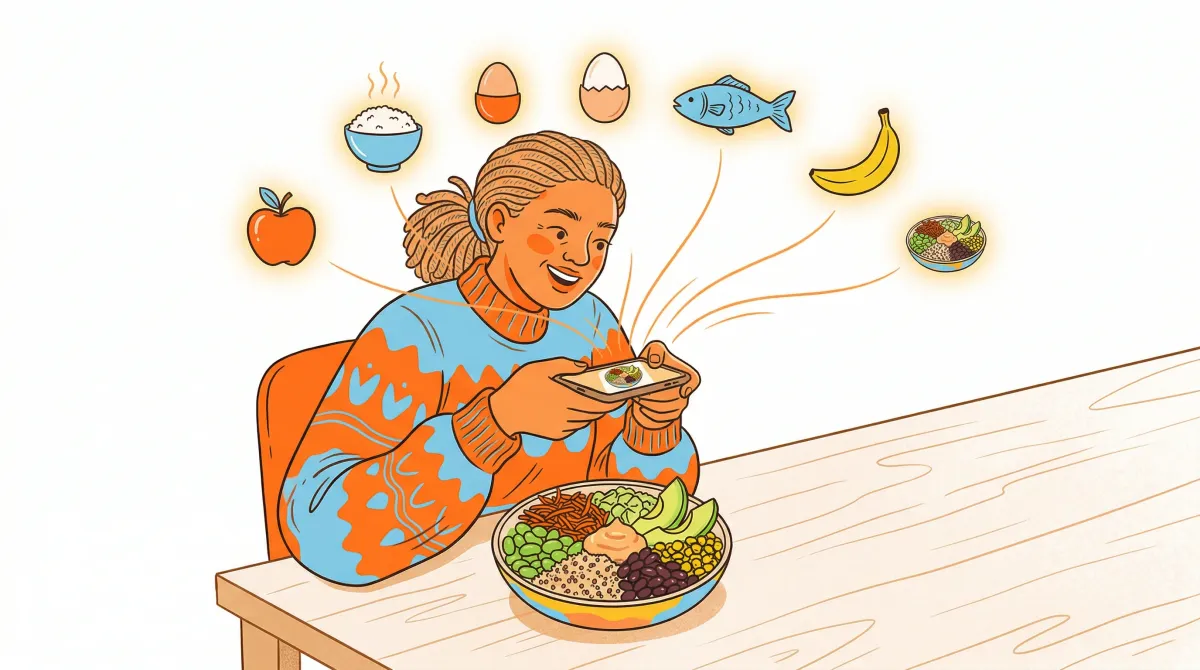
Caloria, the AI calorie tracker, takes a different approach from apps built around database search. The core interaction is a photo — you point your camera at your meal, and the AI identifies what it sees and estimates the portion sizes automatically.
This photo-based model does something traditional database search cannot: it captures how you plate your food. A generic entry for "chicken stir-fry" in a crowdsourced database may reflect someone else's portion. The AI looking at your bowl reflects yours.
Over time, frequently logged meals surface earlier in the interface. The app recognizes your usual breakfast without being prompted. Logging moves from discovery to confirmation — the AI suggests, you verify, and you move on in seconds.
Photo Logging vs. Database Search
Photo-based logging captures portion size visually, which is the variable that most often distorts manual estimates. Research consistently shows people underestimate portion sizes by 20–40% when guessing without measuring — AI photo estimation closes much of that gap without requiring a food scale.
For a broader comparison of how Caloria stacks up against other apps in the category, see our best calorie tracking apps review.
The Science Behind Tracking and Weight Loss
Understanding what calories are is the foundation. Consistently tracking them is what produces results. The mechanism is simple: self-monitoring creates awareness, and awareness changes behavior. Most people who track accurately for the first time discover they were eating 300–500 more calories per day than they estimated.
That awareness — not willpower, not a restrictive diet — is what closes the gap between intake and goals. The challenge is making that awareness sustainable past the initial motivation spike.
Reducing daily logging time from five minutes to thirty seconds per meal is not a cosmetic improvement. For someone eating three meals and two snacks daily, that is roughly 20 minutes per day. Over six months, that is 60 hours of saved effort. The users who stay consistent long enough to see results are almost always the ones whose app demands the least of them.
To understand how the numbers translate to weight change, our guide on calories and weight loss covers the underlying mechanics in detail.
What to Look for in a Calorie Counter App
Not all AI calorie trackers are equal. These are the features that separate tools that get used from tools that get abandoned:
- Photo-based entry — removes the biggest source of daily friction
- Automatic portion estimation — reduces the second-biggest source of error
- Pattern recognition — frequently eaten meals should surface without searching
- Macro breakdown — protein, carbs, and fat matter as much as total calories
- Honest accuracy — consistent estimates you can trust, not crowdsourced guesses
If you are unsure how many calories you should be targeting in the first place, start with our daily calorie intake guide.
Start Tracking Smarter
The best calorie counter app is the one you will actually open tomorrow. AI-powered logging — especially photo recognition that learns your patterns — removes the friction that causes most people to quit before results appear.
Download Caloria and see what's on your plate in seconds:
Medical Disclaimer
This article is for informational purposes only and does not constitute medical advice. Calorie tracking may not be suitable for everyone, including individuals with a history of disordered eating. Consult a registered dietitian or healthcare professional before making significant changes to how you monitor your diet.
Frequently Asked Questions
What is the best AI calorie counter app?
The best AI calorie counter app is the one that fits how you actually eat. For fast, photo-based logging without manual entry, Caloria identifies food and estimates portions from a single photo and tracks macros automatically. For the largest food database, MyFitnessPal has 20 million+ entries but relies on user-submitted data. For verified micronutrient accuracy, Cronometer uses government-sourced data exclusively. See the full calorie tracking app comparison to find the right fit.
Does counting calories actually help you lose weight?
Yes — when done consistently. Research from PMC found that people who tracked their food on more than 66% of days lost nearly 10 pounds over 12 months, while infrequent trackers saw results close to zero. The mechanism is awareness: most people discover they were eating more than they thought, and that knowledge alone drives behavior change.
What is the easiest calorie tracking app to use?
AI photo-based apps have the lowest friction. You snap a photo, the app estimates calories and macros, and you confirm or adjust. No database search, no manual weighing, no typing. This speed difference is the single biggest predictor of whether you will keep using an app at 12 weeks versus dropping off.
Is there an app that counts calories from a photo?
Yes. Caloria uses AI image recognition to identify food items and estimate portion sizes from a meal photo. The app returns a full calorie and macro breakdown — protein, carbohydrates, and fat — in seconds. Several other apps also offer photo logging, though it is often a premium-only feature. With Caloria, photo logging is the core, free feature.
Why do people quit calorie counter apps?
Logging fatigue. A 2024 scoping review of 68 calorie tracking studies found tracking frequency dropped from 5.4 days per week at 4 weeks to 1.4 days per week by 12 weeks. The apps with the best long-term adherence share one trait: they minimize daily effort through automation, pattern recognition, and fast entry methods.